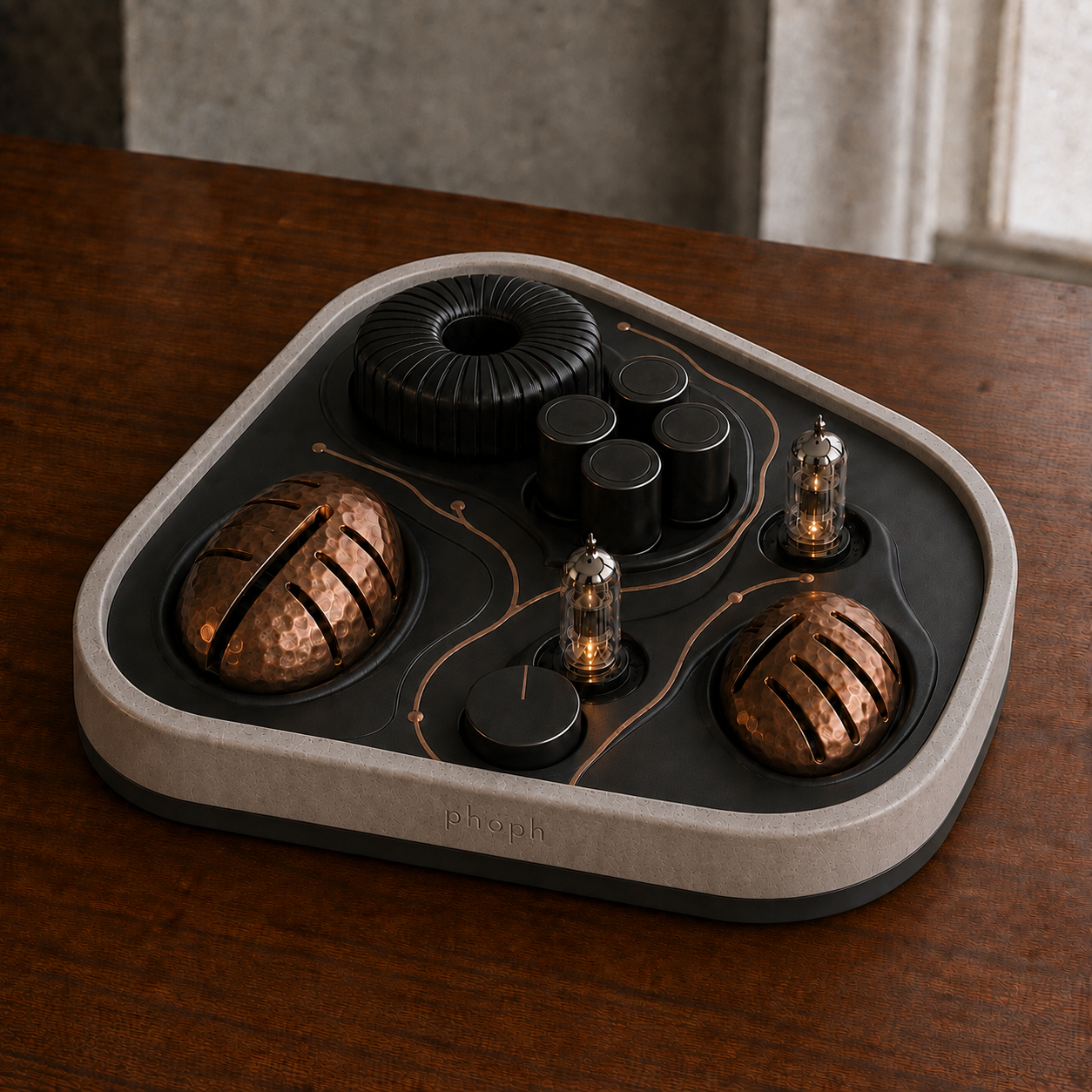
I have lots of ideas for phoph but want to start where I left of in 2017. A hybrid tube amp, low power, just enough to drive a couple of shelf speakers. I will use this to experiment with the phoph design concepts. Tell the story of the electronics of the amplify through its physical design. Stay away from traditional amp layouts. Follow the power, follow the signal.
The AI rendering is more perfect and unrealistic than the pebble will be, but it gives a reasonable impression. Here are some of the design features:
- Sculptural hybrid amplifier — a compact, low-profile object that treats the electronics as part of the visual composition rather than hiding them inside a box.
- Circuit architecture made physical — ECC88 tube voltage amplification feeding a complementary lateral-MOSFET output stage, with the signal path and power flow expressed visibly across the top surface.
- Components become the landscape — toroidal transformer, four reservoir capacitors, two exposed tubes and two copper heatsinks are arranged as distinct functional “forms” rather than conventional rows of parts.
- Material contrast is part of the engineering language — pale concrete, matte black PCB, hammered copper, glass and exposed metal distinguish structure, circuit, heat, power and signal functions.
- Organic flow over industrial grid — visible copper traces connect the functional zones like streams through a landscape. This is almost zen rock garden like, even the heat sinks suggest energy flow.
the electrical specs don’t hold any surprises:
- Topology: stereo hybrid — ECC88 tube voltage gain/driver stages feeding complementary Exicon lateral-MOSFET source followers.
- Output: roughly 8–10 W per channel into 8 Ω, with the MOSFET stage operating Class-AB.
- Power rails: output stage from a 12 VAC secondary, giving approximately ±16 V DC unloaded after rectification/filtering; tube section uses a separate ~62 V HT supply.
- Power supply: toroidal main transformer, bridge rectifier and 4 × 10,000 µF / 25 V reservoir capacitors, plus a separate heater supply.
- Interface/load: conventional line-level stereo input, nominal 8 Ω loudspeakers, passive volume control, with delayed speaker protection on the outputs.
Although the design is slightly curious, most of this simple. One area that is new for me, and not common in the real world is the use of concrete as the material for the housing. It carries a natural feel, a sense of weight and a degree of geometric flexibility that attracts me. I will create a 3D printed version first, smooth its faces, creat a silicon mold and then pour the concrete. An experienced person would create the perfect object. I’m guessing my first attempt will have crumbling edges and air pockets in the faces. Well, stay with me and find out.